


Biodiversity: a challenge for Eiffage Immobilier
As a project owner, Eiffage Immobilier is directly involved in defining, implementing, and designing the project.
This gives it the flexibility to avoid or reduce environmental impacts on fauna, flora, and ecological habitats, but above all to go further, by proposing a project that intelligently strengthens the ecological potential of the site, in order to make the best use of it for biodiversity and for users (fight against heat islands, optimized water management, well-being linked to access to nature and the uses it provides...).
Biodiversity integrated in all stages of real estate promotion
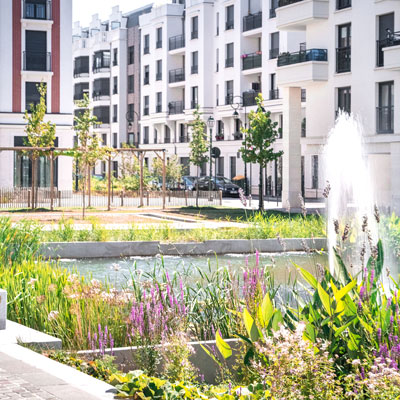
From the design, monitoring and delivery of projects, we are committed to promoting sustainable practices for biodiversity conservation.
We work upstream to characterize the ecological issues of the proposed sites, identify the potential impacts of our projects, and evolve them to limit or eliminate the identified impacts. This is formalized by a flash ecological diagnosis carried out by an internal ecologist or an external study office, from the development stage, in order to feed into the feasibility study of the project. This diagnosis is then complemented by environmental studies relevant to the issues identified.
Environmental compensation is therefore only considered as a last resort. It is carefully designed in consultation with stakeholders (instructor services, communities, associations, etc.). Once the compensation is validated, the construction and landscaping works are carried out by internal or external companies specialized in ecological engineering to optimize the chances of success of the compensation.
During the construction phase, Eiffage Immobilier and its partner Eiffage Construction are committed to limiting the environmental impact of their sites by applying the avoidance and reduction measures defined during the project design, such as: adapting demolition schedules for buildings housing protected species of birds or bats, fencing off areas that need to be preserved to avoid any storage and movement of machinery, adapting construction lighting to limit light pollution on nocturnal fauna, careful and appropriate management of invasive exotic plant species, etc.
Measure to improve
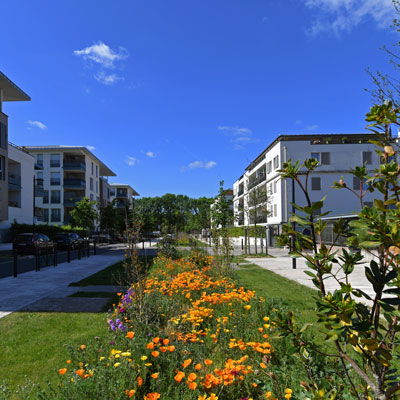
It is not easy to measure the gains for biodiversity of a project which will have placed the ecological context of the site as input to the design. Eiffage Immobilier has chosen to now measure the Surface Biotope Coefficient or SBC on all of its projects, with the objective of improving the SBC of the site after project compared to that of the initial site, and this for at least 50% of projects, from 2023. This indicator, which has the advantage of being known and relatively simple to calculate, is nevertheless imperfect for measuring the ecological performance of a project in terms of biodiversity, which is why Eiffage Immobilier continues to study other indicators which could prove more relevant.
Concerning the artificialization of land, Eiffage Immobilier also measures the rate of artificialization of sites in the initial state hosting its operations, with the aim of reducing this rate of artificialization of the site once the project is completed, on at least 30% of its operations, from 2023.
Although the ecological quality of the project should not be viewed solely from the perspective of artificial soil standards, this standard is still important because living soil is a reservoir of biodiversity, used for rainwater infiltration, and contributes to carbon storage. This is why Eiffage Immobilier wants to prioritize retaining the existing sufficient land on the original site as much as possible in the project design, rather than recreating the solution of sufficient land on the original artificial surface.
The objectives and actions defined for Eiffage Immobilier stem from the Eiffage strategy for Biodiversity and the 4 pillars that compose it, detailed below.
-
Limit soil artificialization on projects
- Reduce artificialization compared to the initial state on 30% of real estate promotion operations by 2023 and on 50% by 2025.
- Measure the percentage of existing open land preserved by the project and set a target for this indicator starting in 2024.
-
Limit light pollution on projects
- Outdoor lighting with beams directed towards the ground, and a color temperature of 3000 K max.
-
Enhance the ecological potential of the project site
- Conduct quick ecological assessments on all our operations from the development phase, to identify issues and guide the project design towards positive biodiversity.
- The main ecological principles are used in landscape projects as design input data (included in the work specifications of landscape architects).
- Measure the Surface Biotope Coefficient of each surface (SBC) before and after the project, and improve the SBC of the site at 50% of the Eiffage Immobilier operation.
-
Design water-saving projects for greenfield management
- Select tree species in all projects that do not require watering and drought resistance, and implement rainwater recycling to irrigate green spaces in 50% of operations.
-
Training Environmental Supervision
- Create internal training and train all Eiffage Immobilier developers and real estate managers to identify and consider environmental regulations applicable to real estate projects.
BiodiverCity® label : a commitment since 2015
The International Biodivercity Property Council (IBPC) is an association created in 2013 to promote urban biodiversity in the construction and real estate sector. It is the originator of the BiodiverCity® label.
Eiffage, through its Sustainable Development and Cross Functional Innovation Department, has been a member since 2015 and participates in:
- The board of directors
- The office
- The technical committee (working group, label improvement, etc.)
Eiffage Immobilier has also been a member since 2020.
The BiodiverCity® label certifies that the real estate project complies with a given level of ecological quality, the objective being that the completed project has a better ecological potential than the initial state of the site. This guideline being that of Eiffage Immobilier for the design of its projects, the BiodiverCity® label therefore makes it possible to highlight and provide objective recognition of the work carried out on the project.
This label is a tool to support projects, which aims to give a new place to green spaces, the quality of gardens and useful ecosystems associated with buildings.
The labeling process for projects has several concrete objectives:
- Raising awareness among all actors in the design and construction team about the specific challenges of each project;
- Integrating the project as best as possible into the existing ecological frameworks around the land;
- Designing an ecological and functional landscape framework that responds to the challenges of the site;
- Integrating living spaces and amenities to encourage contact and use in connection with the nature of future users.
- Maintaining the link after delivery with educational animations and events around nature for residents through its network of local partner associations.
Among our already delivered references, the residents of Smartseille in Marseille and our collaborators working on the Pierre Berger Eiffage campus in Vélizy-Villacoublay, both labeled BiodiverCity® Construction, can already attest to these initiatives in favor of sustainable development linked to the label.
Strongly committed to this environmental and low-carbon approach, Eiffage Immobilier is now offering sustainable real estate projects that respect the environment, ecosystems, and biodiversity.
Biodiversity: a Group approach embedded in the long term
Fully aware of the stakes for future generations and its duty to act, Eiffage has been committed to biodiversity since 2009:
- 2009: Creation of the Master BIOTERRE (Biodiversity Territory and Environment) with the University of Paris 1 Panthéon Sorbonne, a degree program focused on biodiversity, territory, and environmental issues in the fields of design, construction, and operation of development and infrastructure projects.
- 2010: Commitment to the "Countdown 2010" initiative alongside the International Union for Conservation of Nature (IUCN) Europe.
- 2010: Implementation of Eiffage's "Biodiversity" and "Water and Aquatic Environments" charters, establishing biodiversity protection as a strong ambition of the group.
- 2012 to 2018: Commitments continuously endorsed by the Ministry of Ecological Transformation under the framework of the National Biodiversity Strategy (SNB), following France's commitments under the framework of the Convention on Biological Diversity. Two three-year action plans for 2012-2015 and 2015-2018 were formulated and followed up.
- 2018 to 2020: Accredited action plans under the Act4NaturepProgram.
- 2020 to 2022: By submitting its biodiversity action plan for 2020-2022 to the French Office for Biodiversity (OFB), Eiffage has formally developed its biodiversity roadmap and made a two-year commitment within the framework of 'Enterprises committed to Nature - Act4Nature France.'
- 2023 to 2025: Three years of new commitments on a larger scale with OFB, this time involving all of Eiffage's business.
A Group strategy for biodiversity structured around 4 pillars
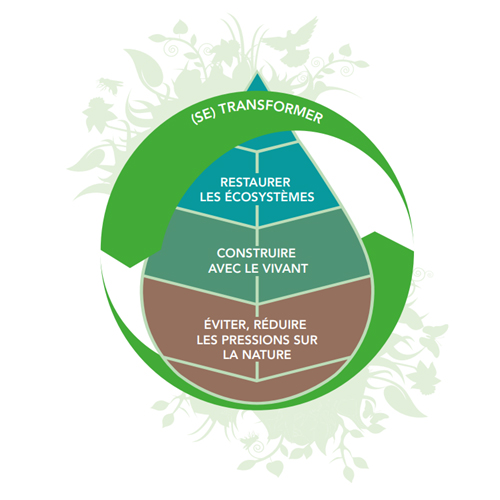
Our strategy is organized around 4 ambitious complementary pillars which aim to:
- Anchor the avoidance and reduction of impacts on nature in practices (pillar 1, the basis of our strategy)
- Bring added value in terms of biodiversity to our operations (pillar 2)
- Accelerate the restoration of ecosystems through the development of green activities (pillar 3)
- Disseminate a responsible approach to transform the Group and its practices (pillar 4)
The first three pillars concern the transition of our activities. Pillars 1 and 2 concern the heart of Eiffage's activities for which it is first necessary to avoid and reduce impacts on living beings (pillar 1), before providing added biodiversity value (pillar 2).
Pillar 3 aims to diversify the Group's activities through the development of new businesses in favor of living beings.
The 4th and final pillar, which surrounds the previous ones, is based on change management and continuous improvement through training, Corporate Social Responsibility, or research.